
Utility Locating vs Ground Penetrating Radar – Understanding the Difference
Before excavation, drilling, or site development begins, knowing what lies underground is critical. Many project managers and contractors are familiar with public utility locate services, but fewer understand when private utility locating or ground penetrating radar (GPR) scanning is also required.
These services are complementary — not interchangeable. Understanding the difference ensures compliance, prevents strikes, and avoids costly delays.
Terraprobe provides both professional utility locating and GPR scanning services across Western British Columbia. This guide explains when each method is needed and how they work together.
What Public Utility Locating Covers
Public locate services (One-Call or BC One Call) mark the location of registered public utilities, typically including:
Electrical distribution lines
Natural gas mains
Municipal water lines
Public sewer mains
Telecommunications trunk lines
However, public locates do not cover:
Private utilities beyond the property demarcation
Building interior services
Non-registered lines
Unknown or abandoned utilities
This gap is where private locating and GPR become essential.
What Private Utility Locating Covers
Private utility locating uses electromagnetic line tracing to detect:
Electrical conduits
Communication lines
Metal piping
Tracer-wire equipped plastic piping
Private locating is effective when a conductive path exists. However, it cannot detect:
Non-conductive materials without tracer wire
Voids
Unknown buried objects
Reinforced concrete structures
Where Ground Penetrating Radar Fits
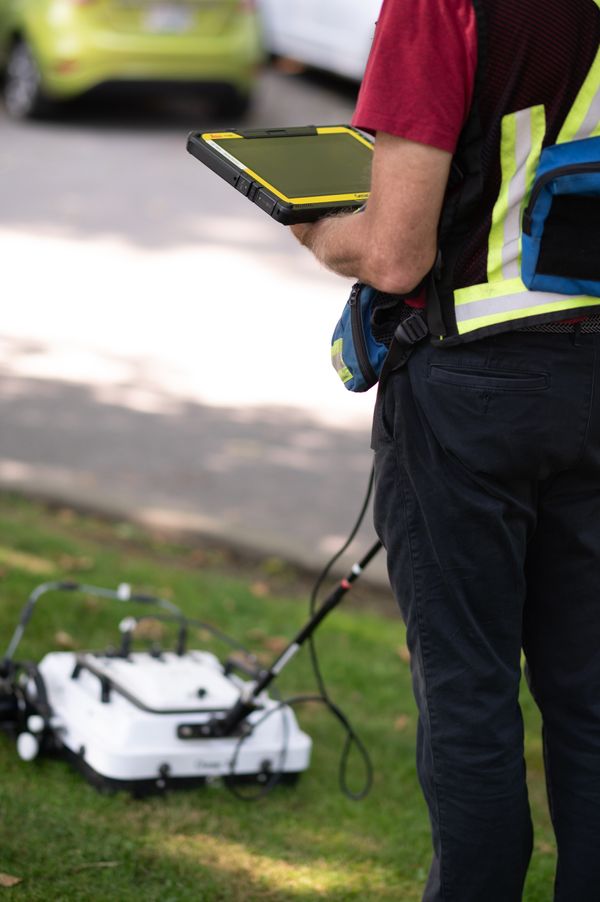
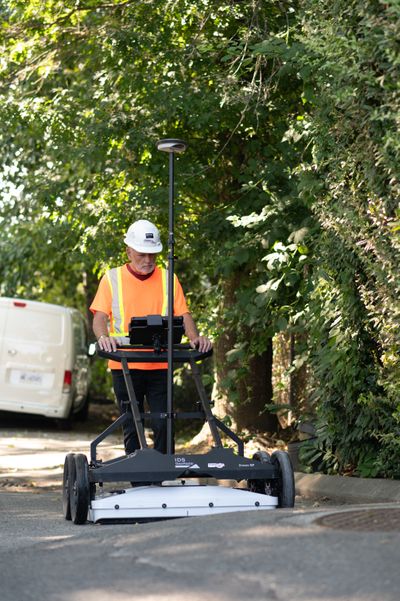
Ground penetrating radar transmits radio waves into soil or concrete and detects reflections from:
Metallic and non-metallic pipes
Buried structures
Concrete slabs and foundations
Tanks and vaults
Voids and disturbed soil
GPR is often used when:
Locates are incomplete
Drawings are unavailable
Non-metallic utilities exist
Subsurface anomalies are suspected
When Do You Need Both?
Most complex projects require a combination of:
Public utility locate
Private utility locating
GPR scanning
Using all three ensures full subsurface awareness and minimizes excavation risk.
Typical Project Scenarios
Site redevelopment
Building expansions
Road and civil construction
Facility retrofits
Concrete demolition
Environmental assessments
Not sure which detection method your project needs?
Terraprobe helps you determine the right approach and provides both private utility locating and GPR scanning services.
FAQ
Does BC One Call locate private utilities?
No. Public locate services only mark registered public utilities. Private utilities require separate locating services.
Can GPR replace traditional utility locating?
No. GPR complements utility locating. Both are often used together for complete coverage.
Can GPR detect plastic pipes?
Yes. GPR can detect non-metallic pipes and voids that electromagnetic locating cannot.